
Crusher Run Calculator
Crusher run — crushed stone mixed with stone dust — packs into a hard, stable surface for driveways, paths and bases. This calculator turns your area and depth into cubic yards and tons, adds a compaction allowance, and estimates the cost and how many truckloads to order.
- Free to use
- No sign-up
- Runs in your browser
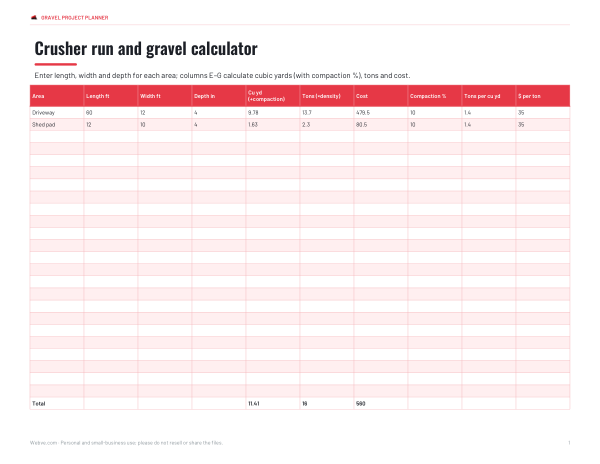
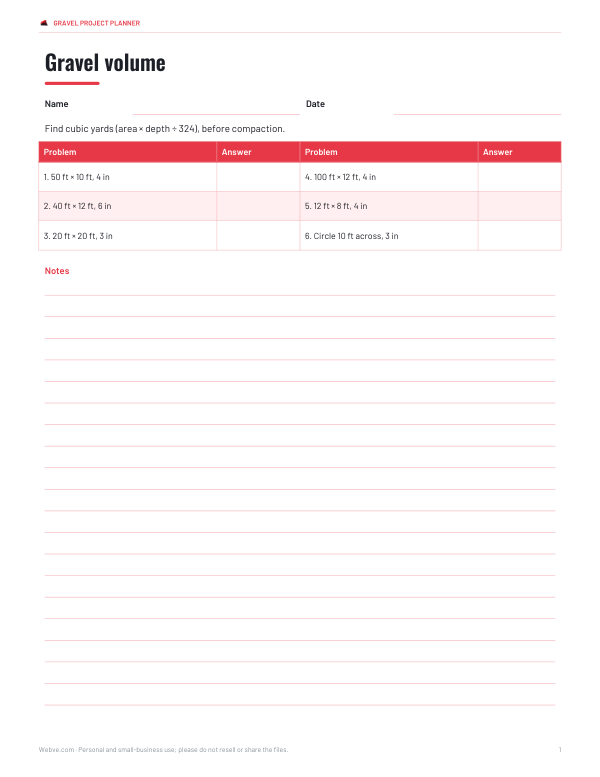
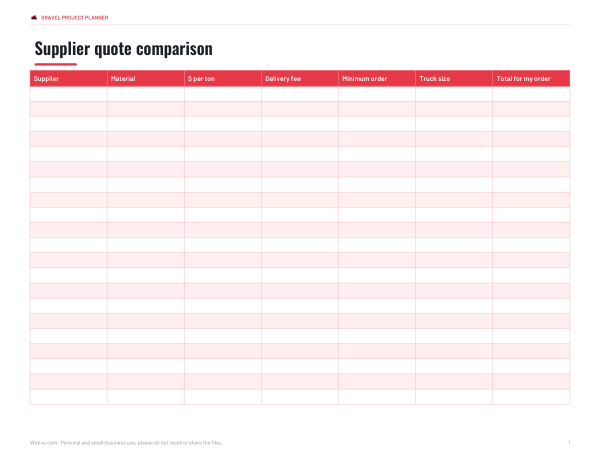
Crusher run calculator
Gravel Project Planner
Excel gravel and crusher run calculator for multiple areas, a driveway planning worksheet, a supplier quote comparison sheet and a gravel type reference card.
- Gravel calculator (XLSX)
- Driveway worksheet (PDF/DOCX)
- Quote comparison (PDF/DOCX/XLSX)
- Gravel type card (PDF)
Formats: XLSX, PDF, DOCX. Instant download after payment (link valid 72 hours, up to 5 downloads). AI-assisted: the templates were drafted with AI help and reviewed and laid out before publishing.
$5.00 USD, one-time 4 files · about $1.25 each
- Instant download
- 7-day refund
- Secure checkout by Stripe
7-day money-back guarantee. Full refund within 7 days of purchase, even after you download.
Free sample: Driveway Planning Worksheet (PDF, 61 KB)
Full refund within 7 days — see the refund policy and license.
Free printables
Single sheets you can print right now, no sign-up. The full pack adds every sheet in one download plus the editable files.
 Printable Gravel Type Card
The formula
- Area: length × width (or π × radius² for circles, ½ × base × height for triangles).
- Volume in cubic feet: area × depth in inches ÷ 12.
- Cubic yards: cubic feet ÷ 27.
- Add a compaction allowance — loose stone compacts by roughly 10–20%.
- Tons: cubic yards × density (about 1.3–1.5 tons per cubic yard for crusher run).
Shortcut: square feet × depth (inches) ÷ 324 = cubic yards.
Worked example: a gravel driveway
A 60 × 12 ft driveway (720 sq ft) with a 4-inch compacted layer: 720 × 4 ÷ 324 = 8.89 cu yd, plus 10% for compaction = 9.78 cu yd. At 1.4 tons per cubic yard that’s about 13.7 tons — so one 15-ton load isn’t enough and the owner orders two loads, or about 14 tons. At $35 a ton the stone costs about $479 before delivery. These are the calculator’s default values.
How deep should crusher run be?
| Project | Typical compacted depth |
|---|---|
| Garden path | 2–3 in |
| Shed or hot-tub base | 4 in |
| Patio or paver base | 4–6 in |
| Residential driveway (over firm soil) | 4–6 in, often over a coarser base on soft ground |
| Driveway on clay or for heavy vehicles | 8–12 in in layers |
| Top-up of an existing drive | 1–2 in |
These are common rules of thumb; soft or wet soils, frost and heavy loads call for more depth or a coarser sub-base.
Crusher run vs other gravels
| Material | Description | Best for |
|---|---|---|
| Crusher run (also called dense grade, quarry process, road base, ABC) | Crushed stone mixed with fines; compacts hard | Driveway surfaces and bases, paver bases, shed pads |
| #57 stone | Clean crushed stone about ¾–1 in, no fines | Drainage, French drains, under-slab |
| Pea gravel | Small rounded stones | Paths and play areas; doesn’t compact |
| Stone dust / screenings | Fine material only | Bedding for pavers in some regions, fine paths |
Names vary by region — describe how you’ll use it to your supplier to make sure you get the right material.
Estimating irregular driveways
Few driveways are perfect rectangles. Break the shape into rectangles, triangles and circle segments, calculate each one and add them up — or measure the length along the centre line and multiply by the average width. For a curved drive, walk the centre line with a measuring wheel. Turning areas and flared entrances are easy to forget and can add a surprising amount of stone, so sketch the drive on paper and label every section before you order.
Ordering tips
| Question for the supplier | Why it matters |
|---|---|
| What is the weight per cubic yard of your crusher run? | Converts your volume to the tons they sell |
| Is it sold by the ton or by the yard? | Avoids ordering the wrong amount |
| What size trucks do you use, and is there a minimum? | Affects the number of deliveries and fees |
| Can the truck spread (“tailgate spread”) the load? | Saves hours of shovelling on long drives |
| What sizes of stone are in the mix? | Coarser mixes are stronger; finer mixes pack smoother |
Delivery often costs as much as the stone for small orders, so combining projects into one delivery can save money.
Cubic yards, tons and tonnes
Quarries sell stone by weight, but you measure a driveway by volume, so density links the two. One cubic yard is 27 cubic feet (about 0.765 cubic metres). A US ton is 2,000 lb; a metric tonne is 1,000 kg, about 1.1 US tons. The calculator shows both, so you can order from suppliers who quote in either unit.
Maintaining a gravel driveway
- Rake loose stone back into ruts after heavy rain.
- Keep the crown or cross-slope so water runs off rather than pooling.
- Clear drainage ditches and culverts at the edges.
- Top up with an inch or two of crusher run every few years.
- Control weeds early before roots break up the surface.
Laying crusher run
- Remove topsoil and roots down to firm subsoil.
- Lay geotextile fabric on soft or clay soils.
- Spread in layers no thicker than about 3–4 inches.
- Moisten lightly and compact each layer with a plate compactor or roller.
- Crown or slope the surface so water runs off to the sides.
- Top up low spots after the first season of use.
Privacy
All calculations run in your browser.
Frequently asked questions
How much does a cubic yard of crusher run weigh?
Commonly about 1.3–1.5 US tons (2,600–3,000 lb), depending on the stone.
How many tons of crusher run for a driveway?
A 60 × 12 ft drive at 4 in deep needs about 13–14 tons including compaction.
How do I convert square feet to cubic yards?
Square feet × depth in inches ÷ 324.
Does crusher run compact?
Yes — allow roughly 10–20% extra for compaction.
How much does a dump truck carry?
Often 10–15 tons for common tandem and tri-axle trucks; ask your supplier.
Can I use metric units?
Yes — switch to metres and centimetres.
How much area does a ton of crusher run cover?
At 4 in deep and 1.4 tons per cubic yard, about 55–60 sq ft per ton before compaction losses.
Should I put fabric under crusher run?
On soft or clay soils, geotextile helps keep the stone from sinking into the ground.
Is crusher run the same as gravel?
It’s a type of gravel: crushed stone with fines that compacts, unlike clean washed stone.
How long does a crusher run driveway last?
Many last for years with occasional top-ups, grading and good drainage.
Can I lay crusher run myself?
Yes for small areas; rent a plate compactor and spread in thin layers.